The Big Guns:
The Mortar and the Dictator
The Mortar
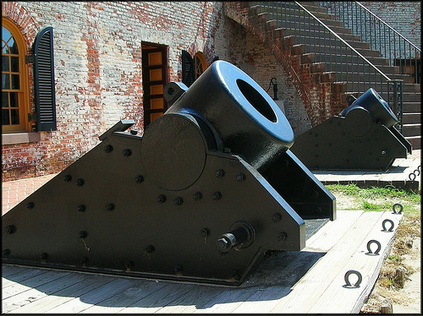
A 10inch mortar like the one Charley mentions.
A part of the "Heavy Artillery" arsenal, the
mortar was a short cannon of sorts that fired large, exploding rounds filled
with shrapnel high into the air, easily reaching the 1,000 yards mark that
Charley talks about in his target practice. Large "Seacoast"
Mortars (like the ones to the right) were often used in the defense of forts
and rivers because their size was not suitable for most forms of
transportation, though some were placed on ships and railroad flatbeds.
Smaller "Siege" Mortars were designed to be lighter and therefore
able to be used by a marching army.
The Dictator
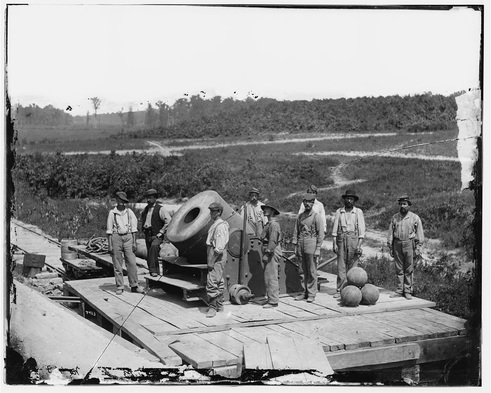
The 'Dictator.'
The Dictator was a 13-inch mortar and one of the most famous
mortars of it's time. It was deployed by
Company G of the 1st Connecticut Heavy Artillery, the same regiment that
Charlie Goodyear came from (though he was in company I). The Dictator was
a "Model 1861 seacoast mortar" that had to be transported by a
special rail car that could support its 17,000 lb. weight.
In terms of The Gunnery’s history, the Dictator has a special spot. The "Stray Shot" was a cannon ball round that came from the Dictator, as told by tradition. The "Stray Shot" name was given to the Gunnery's/town's newspaper which continues today in the form of a once-per-year Literary Journal. The "Stray Shot" is also the name of a cannon ball that is hidden on campus by the previous year's seniors for the current year's seniors to find.
In terms of The Gunnery’s history, the Dictator has a special spot. The "Stray Shot" was a cannon ball round that came from the Dictator, as told by tradition. The "Stray Shot" name was given to the Gunnery's/town's newspaper which continues today in the form of a once-per-year Literary Journal. The "Stray Shot" is also the name of a cannon ball that is hidden on campus by the previous year's seniors for the current year's seniors to find.
Sources:
http://www.civilwarhome.com/artilleryterms.htm
http://www.civilwarartillery.com/basicfacts.htm
Picture: Library of Congress, Prints & Photographs Division, LC-DIG-cwpb-03851 DLC
http://www.civilwarhome.com/artilleryterms.htm
http://www.civilwarartillery.com/basicfacts.htm
Picture: Library of Congress, Prints & Photographs Division, LC-DIG-cwpb-03851 DLC
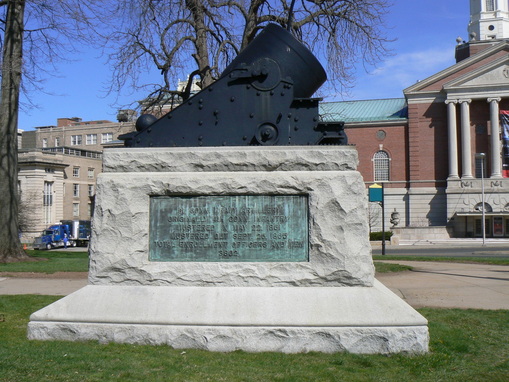
Monument in Hartford Connecticut for the 1st Connecticut Heavy Artillery
